bengarves.com/work/page-redesign
Page Redesign
Project One Pager: 2026 Topic Template Refresh
From Ben Garves’s work at Udemy. Re-created from the original document, with people’s names, internal links and non-public numbers removed or generalized.
Project brief
- Company
- Udemy
- Type
- Project one-pager
- Ben’s role
- Product
- Contributing teams
- Engineering, SEO/Marketing, Product, Design
- Prioritization
- RICE; Now/Next/Later
A one-pager for refreshing Udemy’s Topic page template so it serves searchers who are still exploring a topic, not only those ready to buy. It sets the hypothesis, success criteria, prioritized modules, risks and a test plan.
- Topic pages
- Search intent
- Content modules
- AI search
- Experimentation
RICE Score
Scored with the SEO team’s RICE model. The impact, confidence and effort inputs for each phase:
| Segment | Impact | Confidence | Effort |
|---|---|---|---|
| Phase 1a | 3 | 100% | 8 |
| Phase 2 | 3 | 100% | 3 |
Background
Udemy’s “Topic” pages (example), which currently act as simple aggregators of courses covering similar topics, offer many opportunities for better alignment with a visitor’s position in the shopping funnel. The Topic page’s role at each funnel stage:
- Awareness: Through informational content, educate prospects about the topic.
- Details about how education in the topic can help their career or personal journey or solve a specific problem they have
- Details that solidify this topic as the correct topic for a user to explore (e.g. someone unsure if Python or JavaScript is the right coding language for them to learn)
- Easy wayfinding to adjacent topics if the current one isn’t the right fit to their problem or knowledge gap
- Details about Udemy as a potential solution
- Interest and Evaluation: Educate users about the topic and the depth of knowledge and resources Udemy offers to support their up-skill journey.
- Detailing the depth of knowledge Udemy instructors offer on the topic
- Commonly-asked questions about the Udemy experience and about items frequently covered by courses in the topic
- Wayfinding to CLPs if further evaluation is needed
- Decision and Intent: Give the user helpful tools for evaluating the course that best fits their up-skill need, be it SBS comparison, search, sort, filter, etc.
- Action and Purchase: Enable a seamless purchase flow.
While addressing these informational initiatives, we also have an opportunity to work on infrastructure pieces to improve page performance for Core Web Vitals (CWV) and SSR, which have been informed by recent page optimizations.
Who is the user?
By nature, Topic pages serve users who are in the discovery and exploration phase of both their learning goal (e.g. “What should I learn about Python, and what’s possible using the language?”) and their purchase decision (e.g. “Should I buy a course about Python?”).
For these reasons, there are three types of users we should be speaking to with the content on this page:
| Intent | What they want | How they search |
|---|---|---|
| Exploration | To understand the topic, its scope, and its benefits to their personal or professional life, or its ability to address a specific pain point or knowledge gap. | Broad singular search: “[topic]”, “[topic] course” |
| Comparison | They’ve identified the topic is the right one to learn about, but need to compare the courses available on the topic, along with looking at whether Udemy and its pool of instructors are the best platform to use and experts to learn from. | Comparison searches: “best [topic] course”, “top [topic] course”. Broad plural search: “[topic] courses” |
| Branded Return | They’ve worked with or explored Udemy in the past and want to explore the topic again or explore a different topic, but specifically at Udemy. | Udemy-specific broad search: “udemy [topic]” |
Exploration
- What they want
- To understand the topic, its scope, and its benefits to their personal or professional life, or its ability to address a specific pain point or knowledge gap.
- How they search
- Broad singular search: “[topic]”, “[topic] course”
Comparison
- What they want
- They’ve identified the topic is the right one to learn about, but need to compare the courses available on the topic, along with looking at whether Udemy and its pool of instructors are the best platform to use and experts to learn from.
- How they search
- Comparison searches: “best [topic] course”, “top [topic] course”. Broad plural search: “[topic] courses”
Branded Return
- What they want
- They’ve worked with or explored Udemy in the past and want to explore the topic again or explore a different topic, but specifically at Udemy.
- How they search
- Udemy-specific broad search: “udemy [topic]”
Why is solving these problems big enough to matter?
In SEO, the typical aggregation page (e.g. Category or Tag archives) would have 40–50% of its traffic originating from search queries and AI prompts showing informational/explorational intent.
Our topic pages fall well short of that benchmark, representing both a lack of information on the page to address the concerns of users validating a topic is the right one for them to take a course on, and a lack of topic expertise that would motivate search engines to send this referral traffic to us.
What is the hypothesis?
Providing significant informational content on /topic/ pages will be a long-term boon to their organic search traffic, increasing:
- Ranked keywords
- Organic clicks
- AI citations
- AI mentions
What are the success criteria?
Measured within six months of launch:
- Primary
- Organic traffic growth: an increase in monthly organic search traffic to /topic/ pages
- Traffic mix shift: a growing share of organic search traffic from queries of an exploratory/informational nature
- Ranked keyword increase: growth in the count of ranked keywords for topic pages
- Secondary
- Neutral or positive conversion rate impact
- An increase in average session duration
- A decrease in bounce rate
- An increase in pages per session
What are we building?
Topic pages should:
- Validate that this is the topic a user should take a course on in order to solve a problem
- What is the topic?
- Does the topic fit their problem?
- What will learning this allow them to do, beyond the problem they’re addressing?
- What are adjacent topics that may also be relevant and why (e.g. a user exploring crochet may be interested in knitting, and there are times knitting may be more useful and times crochet may be more useful)
- Who are the experts (our instructors) for this topic?
- (Where relevant) What are average salaries and career opportunities for people who work in that topic’s industry?
- Educate a visitor about the typical learning structure for an average course on that topic
- How long does it typically take to learn the topic as a skill?
- (Where relevant) What are the types of certifications available in the space?
- What would someone learn next, after they master a skill for this topic?
- Tell visitors about Udemy and why we’re the best platform for their upskill journey
- Tell visitors what the best courses are for the topic they’re exploring
- Allow users to search, filter, and sort a list of all courses for the topic
Priority Modules
To make sure we’re driving progress on the revamp in a timely manner, we’ve prioritized the modules we’re touching/creating with a Now/Next/Later approach. Phase 1 (Now) modules, by priority:
- Awaiting test (Pri 0): Updated Lede/Hero
- Updated Course Cards
- Updated Course Directory filters (from SRP)
- Updated Instructor module
- Related Search Queries
- “Filter x Filter” module
- Updated Related Skills/Topics
- Updated Featured Course with playable video
- Updated Quality Recs Carousel
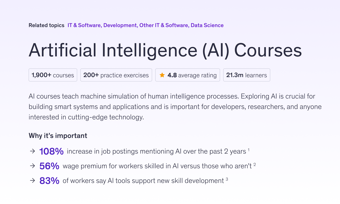
Updated Lede/Hero
Pending final designs via a test on the Certification Topic pages, the new lede focuses on providing more informational content, clarity around what the topic is and why it’s valuable to learn the skill/tool/industry, and helps validate a future purchase decision with social proof.
 (full-size image)
 (full-size image)
 (full-size image)
 (full-size image)
Updated Course Cards
Being brought in from the homepage, these test-optimized course cards are being positioned as the new site-wide standard.
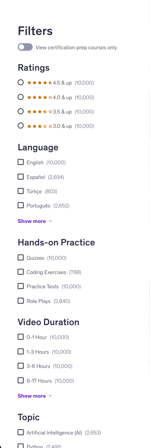
Updated Course Directory Filters
Being brought in from the Search Results Page (SRP), these are also being positioned as the new site-wide standard.
 (full-size image)
 (full-size image)
Updated Instructor Module
A net-new design, this module replaces the old Popular Instructors module with a higher-fidelity, informational experience that includes extra emphasis for a top instructor, along with up to three courses from the four featured individuals.
Related Search Queries
Also being brought forward from the SRP, but with modified styling, the “Related Search Queries” module will recommend adjacent wayfinding to users who are learning the current topic isn’t the ideal fit, dissuading them from pogo-sticking and persuading them to stay in the ecosystem.
![A module titled “Trending [topic] related searches” with a row of pill-shaped search links such as llm engineering, ai programming, large language model, ai bootcamp and ai for beginners.](/media/work/page-redesign/p8-3.png) (full-size image)
(full-size image)“Filter x Filter” Module
Designed to provide quality recommendations to users that align with their learning needs, inspired by real-world filter usage.
![Light-theme module titled “Explore popular [topic] course collections for learners like you” with four color-coded cards that each pair two filters: Top-rated with Under 3 hours, Most popular with Hands-on practice, Prompt engineering with Intermediate learners, and IT Certifications with Expert learners.](/media/work/page-redesign/p8-4.png) (full-size image)
(full-size image)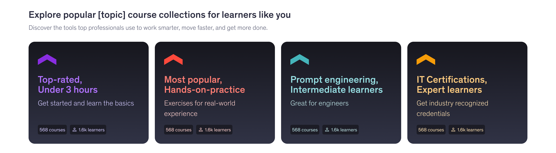 (full-size image)
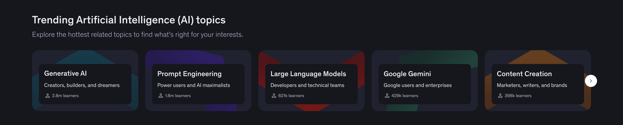
Updated Related Skills/Topics
The Updated Related Skills/Topics module takes an existing experience where it’s unclear the items are buttons and expands it to be informational, helpful, and beautiful. It also gives Udemy the flexibility to scale on a per-Topic basis to cover nuances like tools, adjacent topics and skills, and more.
 (full-size image)
 (full-size image)
 (full-size image)
 (full-size image)
Updated Quality Recommendations Carousel
Emphasizing the highest-quality courses, the updated QRC sends user signals on the ideal courses they should take and pushes wayfinding to high-conversion pages that best represent the experiences Udemy provides.
 (full-size image)
Design Notes
This redesign has five goals for delivering additional value to learners:
- Surface the critical details learners need upfront so they can quickly decide if what they’re seeing is the right fit (inform before they bounce)
- Break up module patterns to create visual interest and make each section easier to scan and parse at a glance (reduce overwhelm)
- Use clear module headers that explain why a recommendation is being made and surface non-course options that help learners refine their intent (lead with context)
- Weave in social proof, trust signals, and expertise to consistently reinforce Udemy’s value as learners explore (build trust)
- Give learners a clear action to narrow or expand their exploration at every stage of their journey (always offer a next step)
The work we deliver should:
| Think atomic, not one-off | Prioritize modules that lay groundwork for future improvements or scale across multiple use cases |
|---|---|
| Include a holistic discovery ecosystem | Consider how modules can scale beyond topic pages to certifications and careers for a seamless end-to-end discovery experience |
| Provide visual clarity through consistency | Patterns should follow function and signal where learners are headed next while making each option feel distinct and easy to explore |
| Spotlight what’s beyond the course | Prioritize modules that showcase non-course features or help learners narrow their intent without defaulting to course recommendations |
| Educate before we sell | Lead with learning context and save the purchase push for after learners understand the value |
Now, Next, Later
We’ve broken our goals into a “now, next, later” model, detailing the things we believe have an ROI worth doing immediately, in a second pass, and eventually:
| Priority Level | Items |
|---|---|
| Now | Update course cards to match SRP/LOHP; Updated hero with additional context (Contextual Header); Provide “focused recommendations” through curated sections within the topic and in lieu of having deep subcategories; Provide filtered/complex recommendations focused on outcome, certifications, and difficulty level; Provide new/trending recommendations through an Uber Module; Provide expert guidance with a Refinement Navigation, allowing users to drill deeper into a topic and into related topics and skills |
| Next | Add trust signals in the form of topic-specific stats; Add expert guidance and outcome-specific jumpoffs; Add curated related searches as navigational items; Add a feed of related blog content; Improve search/sort/filter functionality |
| Later | Improve and resurface curated bundles; Provide recommended related careers; Add “About Udemy” trust signals |
What are the risks?
| Risk | Notes | Mitigation |
|---|---|---|
| Keyword Cannibalization | Doing work that ranks more keywords for /topic/ pages could take traffic away from other pages currently receiving traffic for the same keywords. | Informational keywords have a more natural home on /topic/ pages and not on CLPs. Users will perform better there because content will align with their needs. Topic pages that do a good job of providing a wayfinding experience to users after their informational page should net new traffic to CLPs. |
| User Journey Disruption | We have a good understanding for how our current /topic/ page format performs in our sales funnel, and some CRO work has improved their performance. Adding such significant informational content could disrupt that optimization. | We’re testing full changes on only a subset of pages before the full expansion, which should give us an idea for the SEO benefits without risking the entire portfolio of pages. We will test changes with significant GMV implications on pages not included in the initial /topic/ page test to understand their impact on conversion rate. |
| Content Quality and Accuracy Issues | Scaling this work to the full portfolio of /topic/ pages will require some form of generative AI, as hand-writing informational content for the full portfolio isn’t feasible. | A reliable generative-AI tool is being onboarded. For the test tranche, we’ll have humans read, provide feedback on, and regenerate content where it falls short, informing the level of human-in-the-loop that will be needed for the full rollout. |
Keyword Cannibalization
- Notes
- Doing work that ranks more keywords for /topic/ pages could take traffic away from other pages currently receiving traffic for the same keywords.
- Mitigation
- Informational keywords have a more natural home on /topic/ pages and not on CLPs. Users will perform better there because content will align with their needs. Topic pages that do a good job of providing a wayfinding experience to users after their informational page should net new traffic to CLPs.
User Journey Disruption
- Notes
- We have a good understanding for how our current /topic/ page format performs in our sales funnel, and some CRO work has improved their performance. Adding such significant informational content could disrupt that optimization.
- Mitigation
- We’re testing full changes on only a subset of pages before the full expansion, which should give us an idea for the SEO benefits without risking the entire portfolio of pages. We will test changes with significant GMV implications on pages not included in the initial /topic/ page test to understand their impact on conversion rate.
Content Quality and Accuracy Issues
- Notes
- Scaling this work to the full portfolio of /topic/ pages will require some form of generative AI, as hand-writing informational content for the full portfolio isn’t feasible.
- Mitigation
- A reliable generative-AI tool is being onboarded. For the test tranche, we’ll have humans read, provide feedback on, and regenerate content where it falls short, informing the level of human-in-the-loop that will be needed for the full rollout.
How will we go to market with this launch?
The SEO team is planning two types of testing before doing a global launch of this project:
| Test/Phase | Scope |
|---|---|
| Phase 1a | Launch content-redesigned /topic/ pages for 25 topics, then monitor them for their organic search performance and their impact on performance of adjacent pages (e.g. cert vouchers, CLPs). These pages will use existing modules, plus any new module where we’re surfacing HTML/CSS informational content. |
| Phase 1b | Run experiments on existing /topic/ pages to measure the incremental GMV and CRO impact of changes to this type of page. These tests will be for incremental updates to existing modules and testing new modules that have dynamic needs and can’t be surfaced in HTML/CSS. |
| Phase 2 | If the redesign test succeeds in significant lift in organic search traffic and the GMV impact of experiments is net-neutral, expand the new template to all /topic/ pages. |
Test Tranche
The following pages will be used in the initial test of 25:
- https://www.udemy.com/topic/business-strategy/
- https://www.udemy.com/topic/digital-product/
- https://www.udemy.com/topic/business-development/
- https://www.udemy.com/topic/communication-skills/
- https://www.udemy.com/topic/data-analysis/
- https://www.udemy.com/topic/microsoft-power-bi/
- https://www.udemy.com/topic/graphic-design/
- https://www.udemy.com/topic/mlops/
- https://www.udemy.com/topic/aspnet-mvc/
- https://www.udemy.com/topic/cms/
- https://www.udemy.com/topic/data-science/
- https://www.udemy.com/topic/machine-learning/
- https://www.udemy.com/topic/mobile-app-design/
- https://www.udemy.com/topic/natural-language-processing/
- https://www.udemy.com/topic/python/
- https://www.udemy.com/topic/sql-server/
- https://www.udemy.com/topic/web-development/
- https://www.udemy.com/topic/snowflake/
- https://www.udemy.com/topic/ai-agents/
- https://www.udemy.com/topic/amazon-aws/
- https://www.udemy.com/topic/artificial-intelligence/
- https://www.udemy.com/topic/cloudflare/
- https://www.udemy.com/topic/cyber-security/
- https://www.udemy.com/topic/drawing/
- https://www.udemy.com/topic/digital-marketing/
- https://www.udemy.com/topic/excel/
- https://www.udemy.com/topic/english-language/