bengarves.com/work/ai-metadata
AI Innovation - Metadata
Project One Pager: Optimized CLP Metadata
From Ben Garves’s work at Udemy. Re-created from the original document, with people’s names, internal links and non-public numbers removed or generalized.
Project brief
- Company
- Udemy
- Format
- Project one-pager
- Product
- Ben Garves
- Prioritization
- RICE
- Page type
- Course landing pages (CLPs)
- Fields
- SEO title, meta description, URL slug
Proposes replacing instructor-written course fields as the source of course landing page SEO titles, meta descriptions and URL slugs with LLM-generated, search-optimized metadata, aiming for higher click-through rates and better rankings.
- AI
- Metadata
- Technical SEO
- SERP
Background
Udemy currently relies on instructor-written content for its CLP metadata, utilizing existing course admin fields to determine a CLP’s SEO title, meta description, and URL slug.
Because we’re using those fields, they’re not optimized for organic search and AI crawlers, netting poor keyword usage, poor phrasing, and the existence of special characters that aren’t read well by search engines.
For example (course titles and details replaced with placeholders):
“Hello friends! Welcome to [course title]. [Topic] has become…”
“<p><strong><em>[First sentence of the description]…”
“Welcome to [course title], where you learn [subject] from basics: [subject] from basics to advance level…”
“<p>Welcome to <strong>“[course title],”</strong> a…”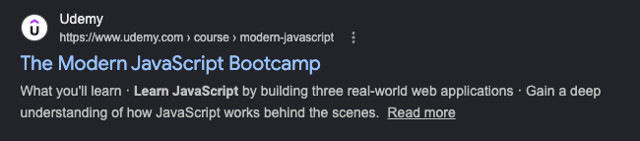 (full-size image)
 (full-size image)
In fact, because CLP meta descriptions are pulling the entirety of the course description, they can often be more than 15,000 characters, versus Google’s preferred ~150.
Who is the user?
Any Google user completing searches where Udemy has relevant course content.
Why is solving these problems big enough to matter?
Visitors use SEO titles and meta descriptions to judge whether a search result is the right fit for them, ultimately deciding whether to click on the result. Google tracks whether the information we provide drives high engagement rates on their results page, demoting content that didn’t resonate with users.
What is the hypothesis?
Improving the metadata we deliver to Google will yield higher click-through rates from SERPs and improved rankings on those pages.
What are the success criteria?
| Metric | Goal |
|---|---|
| Average position | Improve (rank higher on average) |
| Click-through rate | Increase |
What are we building?
Replace metadata pulling from instructor-written sections with search-optimized titles and descriptions generated by an LLM after reading the course’s content.
- SEO title
- URL slugs
- Descriptions
- Branded keyword inclusion
What are the risks?
| Risk | Details | Mitigation |
|---|---|---|
| Instructor sentiment | Instructors educated in SEO or AI usage may want to customize their meta descriptions. | If we see significant feedback and/or decreased rankings for some pages, it would be worth providing instructors with a purpose-built field for meta descriptions. |
| Duplication | LLM-generated content on similar topics could result in similar titles and descriptions. | Generation prompts will include a requirement that descriptions include a “taught by” instructor callout. For bulk processing, descriptions should go through a deduplication process with a goal of at least 20% wording variance for similar courses. |
Instructor sentiment
- Details
- Instructors educated in SEO or AI usage may want to customize their meta descriptions.
- Mitigation
- If we see significant feedback and/or decreased rankings for some pages, it would be worth providing instructors with a purpose-built field for meta descriptions.
Duplication
- Details
- LLM-generated content on similar topics could result in similar titles and descriptions.
- Mitigation
- Generation prompts will include a requirement that descriptions include a “taught by” instructor callout. For bulk processing, descriptions should go through a deduplication process with a goal of at least 20% wording variance for similar courses.
How will we go to market with this launch?
| Field | Plan |
|---|---|
| Meta descriptions | Deploy to a page subset where CLPs are underperforming averages for SERP position and CTR. Test on a subset (100 pages) of CLPs performing well with SERP position and CTR to determine if global rollout would be beneficial. |
| URL slugs | Only generate for net-new CLPs moving forward. |
| SEO titles | Deploy to a page subset where CLPs are underperforming averages for SERP position and CTR. Test on a subset (100 pages) of CLPs performing well with SERP position and CTR to determine if global rollout would be beneficial. |