bengarves.com/work/new-page-templates
New Page Templates
Project One Page: Free Lectures/Lessons Page
From Ben Garves’s work at Udemy. Re-created from the original document, with people’s names, internal links and non-public numbers removed or generalized.
Project brief
- Company
- Udemy
- Type
- Project one-pager
- Product
- Ben Garves
- Team partners
- Engineering, DS/ML, Marketing/SEO
- Prioritization
- RICE score
- MVP scope
- One manually curated page under the Artificial Intelligence topic page
A one-pager proposing a hub page of free sample lectures from Udemy’s AI courses, each framed around a question learners search for, to test lecture-level content as a new search entry point with a direct path to the full course.
- SEO
- AI search
- Video lessons
- Landing pages
Background
Udemy courses include publicly-available sample videos drawn directly from the course curriculum. These lecture videos are typically 3–10 minutes long, are already accessible to logged-out users, and frequently answer high-value questions that users are actively searching for.
This project is motivated by three factors:
- Udemy's content is not conducive to users looking for a learning solution that requires less time commitment.
- Informational content that used to be a lead driver for organic search is now being usurped by AI-generated answers (AIO, AI Mode, and other AI platforms).
- Udemy has a strong library of lecture-sized content already available to users, but it's not indexable and is difficult for users to find.
We see strong indicators that users are interested in free content (our Free Courses page draws large search-impression volume), but a free course doesn't create a natural path to a paid one: a user who completes a free course has satisfied their learning need.
Lecture-level content creates a high-intent entry point and a logical upsell if the user determines they want to continue to pursue the full course. We also see much higher quality in our sample lectures, which were recorded and selected by an instructor specifically for their ability to sell a course.
Who is the user?
| User | Description |
|---|---|
| Time-Limited Users | Users with a limited amount of time to dedicate to learning who want to understand Udemy's ability to deliver quick-hit content specific to their needs. |
| Question-Specific Users | Users searching with question queries/prompts because of a specific challenge they need to overcome. These queries don't exist naturally at the course level, but can exist at the lecture level. |
| Search Engines and AI Platforms | These platforms are actively looking for logical entry points for user handoff when they're unable to satisfy a user's needs with an LLM or agent. |
Why is solving these problems big enough to matter?
- We need to address the way the top of our funnel has changed due to the AI landscape.
- Free content-related queries receive very large monthly search volume on search and AI platforms, but we've been unable to capture and convert those searches into users.
- We have a vast library of quality lecture content that's already available to logged-out users but can't be crawled and is hard to find.
What is the hypothesis?
- Surfacing lecture-level content in organic search will attract what we formerly considered to be mid-funnel users with high purchase intent.
- The FAQ-style structure (one question per lesson) will match granular search queries that AI-generated answers don't have the ability to answer with multimedia content.
- Watching high-quality free lectures creates a stronger purchase intent than completing a free course.
Additionally, this page will validate whether lecture-level content is a viable new top-of-funnel entry point to replace informational content being usurped by AIO.
What are the success criteria?
- Monthly organic search referrals: measured over the first 6 months after launch
- Net-new annualized GMV: measured over the first 6 months after launch
- Hypothesis validation: validate lecture-sized content as a viable entry point
What are we building?
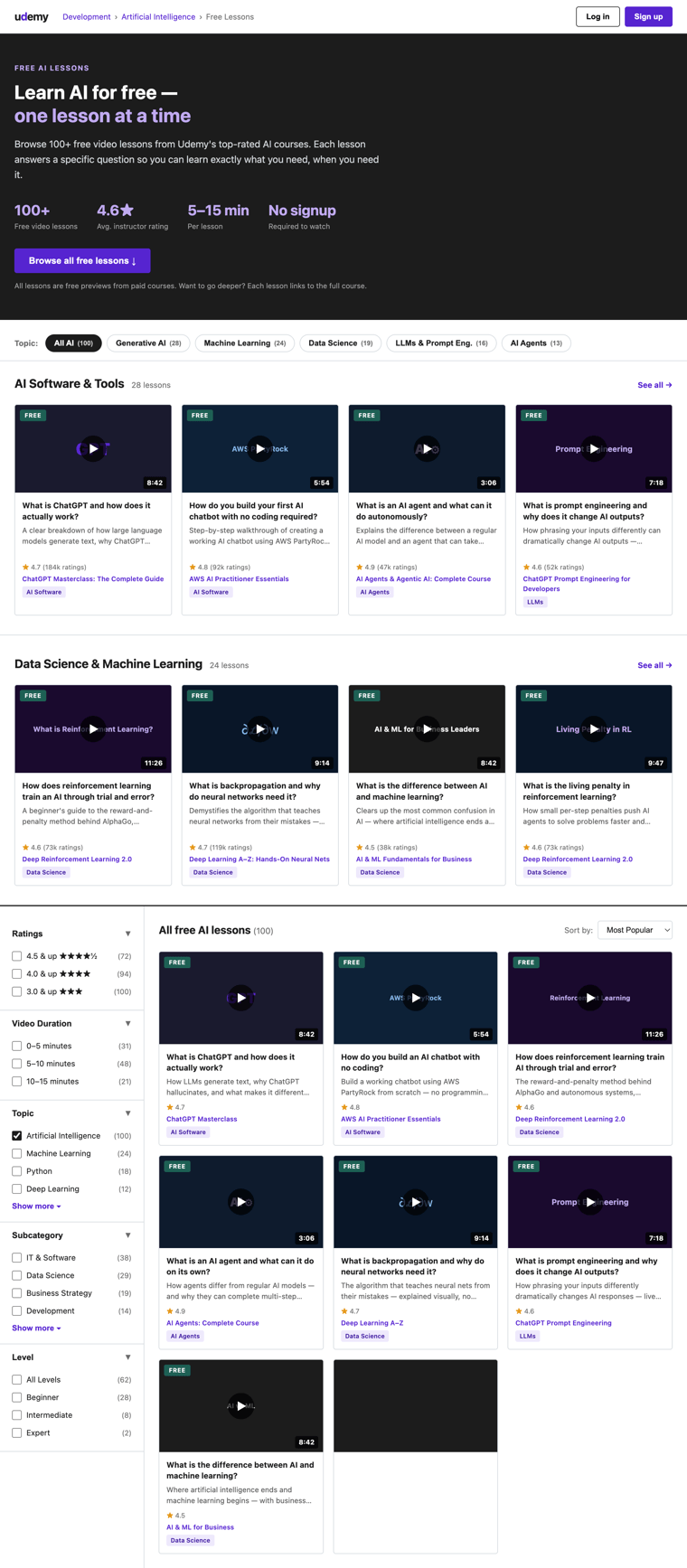
This project will focus on finding and surfacing 100 high-quality sample lectures from the courses on the Artificial Intelligence topic page, and:
- Deliver them in a hub-style experience with sort/filter functionality
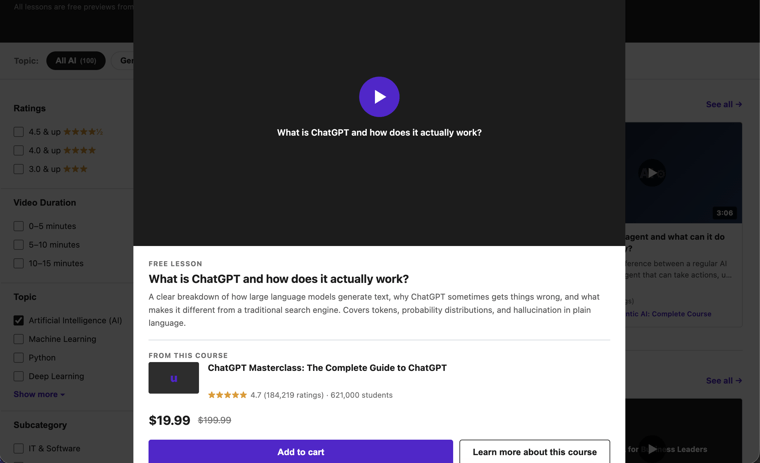
- Provide keyword-focused titles and summaries of what the lectures cover
- Offer on-page add-to-cart and a secondary CTA to learn more about the source course
 (full-size image)
 (full-size image)
What are the risks?
| Risk | Description | Mitigation |
|---|---|---|
| Lecture content misses user needs | If lecture-level content doesn't match user needs, the page won't attract the organic search traffic it targets. | We're starting with a high-demand topic with a strong library of lecture content that answers specific questions with significant search volume. |
| Intent Satisfaction | The free content meets the needs of users and we see high traffic but low conversion rates. | When curating lectures to be included on the page, we will focus on content that has logical next steps and where the instructor does a good job of advocating for their course. |
| Manual Curation | Manually curating this content is resource-intensive and may be difficult to sustain. | If this AI topic MVP is successful, architecture will need to be built to streamline the generation of these pages and the curation of the content that goes on them. |
Lecture content misses user needs
- Description
- If lecture-level content doesn't match user needs, the page won't attract the organic search traffic it targets.
- Mitigation
- We're starting with a high-demand topic with a strong library of lecture content that answers specific questions with significant search volume.
Intent Satisfaction
- Description
- The free content meets the needs of users and we see high traffic but low conversion rates.
- Mitigation
- When curating lectures to be included on the page, we will focus on content that has logical next steps and where the instructor does a good job of advocating for their course.
Manual Curation
- Description
- Manually curating this content is resource-intensive and may be difficult to sustain.
- Mitigation
- If this AI topic MVP is successful, architecture will need to be built to streamline the generation of these pages and the curation of the content that goes on them.
How will we go to market with this launch?
The MVP is a single, manually-curated page under the current Artificial Intelligence topic page. It can be syndicated and promoted through social and paid channels, along with adding a callout on the current AI topic page.
If successful, the project will lead to building scalable architecture for expanding this page type to live under all topic pages.